Exploring Business Agility

In a business context, agility is the ability of an organization to rapidly adapt to market and environmental changes in productive and cost-effective ways.
The adoption of business agility mindsets, structures, and practices is accelerating. Despite the hype, it’s more than a buzzword. It is a significant, yet nuanced, change in the ways companies operate. In today’s unpredictable economy, the benefits are clear.
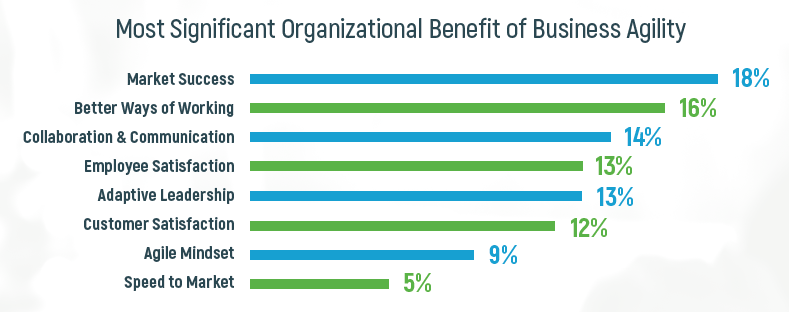
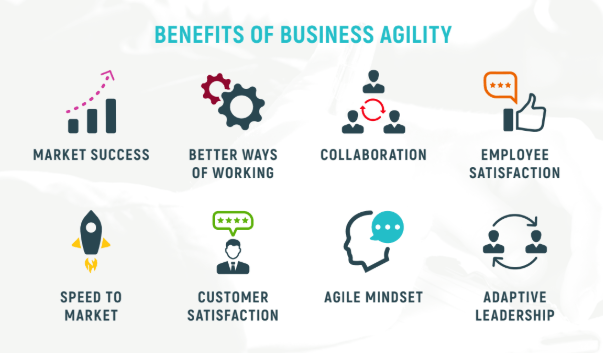 According to the 2018 Business Agility Institute (BAI) Report, one of the primary goals of business agility is to improve market success. Not just by working more efficiently, but by developing new ways of delivering customer value and bringing the right products to market faster. Survey respondents in the BAI Report indicated that they have seen market success through improved business development, recognition by their customers, and improved product or service delivery.
Company Size Correlates to Business Agility
It should come as no surprise that small organizations have more agility than large organizations. Business agility plateaus at around 50 employees, with the fluency of larger organizations dropping an average of between 16% and 27%.
As organizations grow, they put in place extra processes and systems to handle the growing complexity. This is especially true of organizations above 150 people (Dunbar’s Number). Without clear design, it’s easy to fall back on traditional processes, which are designed to scale management rather than business agility processes, which are designed to descale complexity.
Key Challenges to Business Agility
Many organizations struggle with entrenched cultures and outdated processes that hinder business agility. The most common challenges include:
-
Leadership Challenges: Lack of support from leadership can delay transformation efforts.
-
Lack of Buy-In: Getting buy-in from employees across levels can be a barrier.
-
Inappropriate Organization Design: Rigid structures often inhibit agility and flexibility.
Despite these challenges, most respondents to the BAI Report still report tangible benefits from their investment in business agility. These benefits include:
-
Better ways of working
-
Increased employee satisfaction
-
Higher customer satisfaction
-
Improved market performance
The Importance of Involving Every Team, at Every Level
To achieve true business agility, every team in every division should be included in the transformation journey. Most companies start with the easiest divisions, often Technology, and expand to other areas over time. The data from the BAI Report shows that the more teams and functions involved in the transformation, the higher the agility fluency across the organization.
While Finance and HR departments are typically slower to transform, organizations that do prioritize these functions report higher outcomes in business agility.
Get Started to Get Ahead
So, how do you start implementing business agility? Or, better yet, how do you sustain business agility across your enterprise? The proven Enterprise Business Agility Model shows you how to enable measurable and sustainable enterprise business agility transformations across all areas of business operations and delivery. This model helps your organization achieve true business agility – so you can adapt and change, learn and pivot, deliver at speed, and thrive in a competitive market.