What Is Enterprise Business Agility?

Evolving from “Agile Transformations” to “Enterprise Business Agility”
A major shift is underway—organizations are moving beyond traditional Agile transformations and embracing Enterprise Business Agility (EBA). While Agile focuses on improving delivery within IT, EBA offers a holistic approach that enables agility across the entire business.
Why the shift? Because optimizing delivery alone hasn’t delivered the business outcomes leaders expected. Despite investing millions, many executives still say:
-
“Our teams aren’t aligned to the right business outcomes.”
-
“We’ve become feature factories—burning out with no clarity on the value we deliver.”
Agile is a tool, not the destination. Business Agility is the true goal.
What Is Business Agility?
Defined by Evan Leybourn (Business Agility Institute) and Sally Elatta (AgilityInsights®), business agility is:
“The ability to adapt to change, learn and pivot, deliver at speed, and thrive in a competitive market.”
In today’s world, fast beats slow—regardless of size. The organizations that learn and deliver faster gain the only sustainable advantage.
The Enterprise Business Agility (EBA) Journey
1. Team Agility
Introduce Agile practices (Scrum, Kanban), form cross-functional teams, co-locate workspaces, and implement basic Agile tools. This builds foundational team-level agility.
2. Team of Teams Agility
Scale Agile across teams to address planning, dependencies, and DevOps maturity. Invest in leadership development—especially managers—to support a collaborative, value-driven environment.
3. Organizational Agility
Adopt Lean Portfolio Management to align execution with strategic themes. Design value streams and implement product discovery to mature product management capabilities.
4. Talent, Innovation & Operational Agility
HR, Finance, Sales, Legal, and Marketing must join the agility journey. Focus on enterprise-wide collaboration, customer empathy, and operational innovation.
5. Achieving Enterprise Business Agility
You’ve reached business agility when your organization anticipates customer needs, disrupts markets before being disrupted, and continuously improves as a learning organization.
Business Agility Is Real—and Urgent
In a McKinsey Quarterly survey, over 75% of respondents listed Organizational Agility as a top-three priority. Yet many face major blockers:
-
Competing priorities
-
Tech vs. business silos
-
Limited customer feedback
-
No shared measures of success
To succeed, organizations need a holistic strategy and clarity on where to invest.
The 7 Pillars of the Enterprise Business Agility Model
The EBA Model provides a non-prescriptive, integrated approach across seven key investment areas:
Current Organizational Challenges
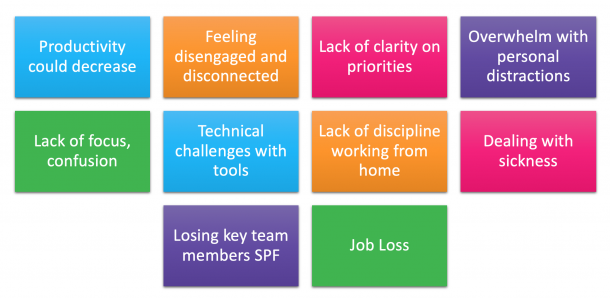
We’ve captured from several executives the most common challenges getting in the way of companies executing on their strategy.
The issues range across all areas of the business and include competing priorities, slow time-to-market, tech vs. business teams, heavy dependencies and silos, limited voice of the customer, not measuring what matters, and the list goes on. See image below for more.
The EBA Model and Assessment
To enable Enterprise Business Agility, leaders should create a holistic approach around 7 key areas of investment, shown in the image below. The Enterprise Business Agility model provides senior leaders with a strategy and scope for where to invest in order to accelerate and achieve their Enterprise Business Agility transformation vision. It is a non-prescriptive, pull-based model that provides patterns and integrates with Agile, Scrum, Kanban, & SAFe®.

Customer Seat at the Table
Build the capability of being a customer-focused organization where decisions about the products are made based on aligning customer needs and using lean startup, experiments, discovery practices and metrics to guide our solutions.
Lean Portfolio Management
Build the capability of translating your strategy to 3 year, 1 year and quarterly outcomes (using Objectives & Key Results). Align all teams, business and technology around achievement of these outcomes. Plan quarterly and shift funding models to fund capacity instead of projects.
Org Structure & Team Design
Build the capability to virtually align and organize teams (business and technology) around business outcomes, break dependencies, design for shared service teams and optimize for FLOW of value.
Agile Framework & Mindset
Build the capability to create an Agile mindset across the enterprise. Bring agility to technology and business teams. Scale Agile to mature planning and execution across teams.
Leadership & Culture
Build the capability to transform leaders to lead the new way of working. Enable Leadership Agility by shifting from a top-down, directive style to create an environment to support autonomy for teams. Invest in the role of managers, shift leaders up away from tactical focus to being more strategic. Bring clarity to vision, strategy and outcomes, develop talent, and remove organizational obstacles.
Make It Stick/Sustain
Build internal change agents to sustain the journey, measure and continuously improve, and bring HR to the table by being part of the Agile talent transformation.
Technology Agility
Invest in technical agility by modernizing your architecture and platforms, embedding the right technical practices, investing in DevOps and enabling a culture of innovation.
Enterprise Agility Metrics
Measure what matters at the team and organization level by combining maturity (qualitative), performance (quantitative) and outcomes (results) across the enterprise. Focus on value, quality and flow.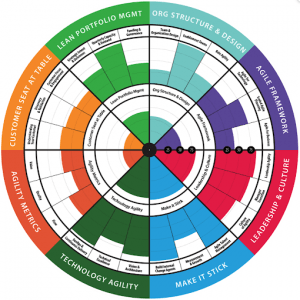
Getting Started
Most organizations are on different stages of the Enterprise Business Agility journey and have already invested in some of these capabilities. To accelerate this journey, we recommend assessing your current state and designing an integrated strategy with a cross-functional leadership team.
So here are some options for getting started:
- Schedule a 2-hour EBA seminar for your leaders to learn more.
- Schedule a half-day EBA baseline assessment to see where you are now and identify next areas of investment.
- Schedule a 1-day EBA for Leaders/Executives workshop.
- Get certified as an Enterprise Business Agility Strategist (EBAS) so you can help lead this change within your organization.
View details about these workshops here.
Final Thoughts
The road to business agility is long—but clarity, data, and strategy accelerate the journey. Build an integrated approach, align your leadership, and measure what matters.
Enterprise Business Agility isn’t a buzzword—it’s a business necessity.