How Agile Insights Helped Save $6M and Drive Business Value

“The greatest enemy of good thinking is busyness.” That quote, by Dallas Willard, hits hard when you’re neck-deep in an enterprise transformation. One financial services company found itself there. Constant change. Inconsistent output. Agile implementation supposed to fix it—but it didn’t. Yet.
The teams were shifting constantly. Priorities were misaligned. Data was scattered across spreadsheets. Leadership had a simple, pressing question: “How can we get more output from the same teams without burning them out?”
This article unpacks exactly how that question led to a $6M cost reduction and $25M in new value—within a year. You’ll learn what worked, what didn’t, and how you can use the same data-driven approach to improve your organization’s Agile maturity.
The Challenge: Output Misalignment and Hidden Inefficiencies
A large financial services client approached us with a familiar issue. They were struggling to meet increasing customer demands, comply with tighter regulations, and stay competitive. Agile transformation was underway, but results lagged expectations.
Their core challenges included:
- No visibility into patterns across teams
- Inspect-and-adapt data stuck in PowerPoint decks
- Output expectations misaligned with actual team capacity
- Teams failing to deliver business-aligned outcomes
Agile practices were in place, but without results. Why?
Baseline Team Health with AgilityInsights®
To bring clarity to chaos, we introduced the AgilityInsights® TeamHealth Radar Assessment. Leadership agreed to pilot it across more than 90 teams.
Get a clean readout of where things stood.
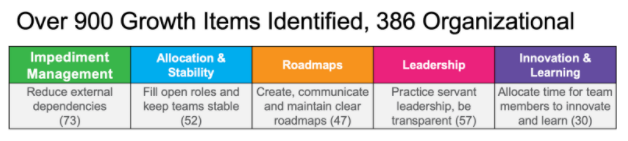
Within weeks, the organization had a data-driven map of:
- Which teams lacked a defined backlog
- Where roadmaps were unclear or misaligned
- Which dependencies and impediments slowed delivery
Most telling: the insights matched what inspect-and-adapt sessions had shown over the previous two years. But back then, leaders had dismissed the data. This time, it came from the teams themselves. That made all the difference.
The ROI of Slowing Down to Speed up
Equipped with this knowledge, leaders took the time to slow down and ensure teams had what they needed to perform their jobs efficiently. Leaders also developed a better understanding of where they needed to step in to help the teams. The organization re-focused efforts on building a sufficient backlog, aligned with a roadmap, so teams could identify dependencies earlier in the development lifecycle.
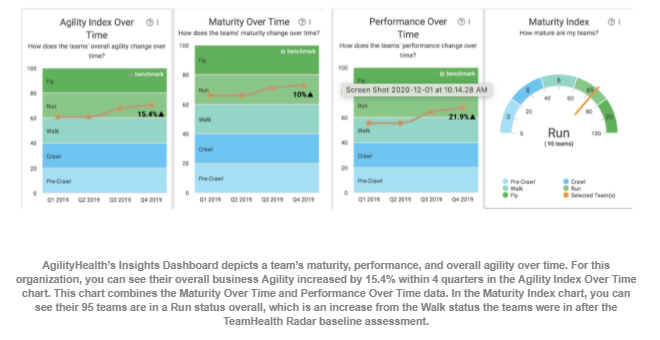
This intentional slow-down drove a return on investment in less than a year and $6M in cost savings—equivalent in productivity to the work of five extra teams—while generating an additional $25M in value for the company.
By leveraging the results of the AgilityHealth assessment, leaders now had the data they needed to take action, along with:
- A repeatable process for collecting and measuring continuous improvement efforts at the end of every planning increment (PI)
- The clear understanding of where teams stood in their Agile journey and next steps for maturity
- Comprehensive baseline assessment results showing where individual team members thought improvement was needed, both from leaders and within the teams

Institutionalizing Agility: What Came Next
Agile transformation isn’t a one-and-done project. To sustain improvement, the client committed to scaling assessments across functions and maturity levels.
Their next steps:
- Implement AgilityInsights® Talent Development Assessments to assess role maturity and skills gaps
- Improve structural agility by tracking and evolving team composition to better align with outcomes
- Use consistent team health metrics to correlate performance with customer satisfaction and product delivery
This approach ensured every change was tied to measurable impact. It also fueled leadership confidence in scaling Agile without losing alignment.
Takeaways for Your Agile Transformation
Here’s how to replicate these results in your organization:
- Start with real data. Don’t assume you know where the blockers are. Ask your teams. Use validated tools like AgilityInsights®.
- Treat assessments as the beginning, not the end. Baselines show you where to start, but follow-through is where the value is unlocked.
- Don’t fear slowdowns. Sometimes you need to pause to reset. That intentional slowing down helped this client recover momentum fast.
- Invest in role-based assessments. Teams are only as agile as their members’ understanding of Agile roles and responsibilities.
- Make data visible and actionable. Dashboards, visualizations, and regular PI-level health checks keep progress transparent.
Ready to Boost Your Output?
If you’re investing in Agile but not seeing the ROI, it may be time to baseline your team health and Agile maturity. Start with tools that reflect the voice of your teams. Book a demo of AgilityInsights® and learn how you can unlock measurable outcomes, faster delivery, and lasting agility.
Because speed doesn’t matter if you’re heading in the wrong direction.