Fund Your Transformation Efforts through Increased Agile Capitalization

With the severe impact of COVID-19, many organizations have paused critical transformation and improvement initiatives. Whether it’s due to uncertainty about the future, shifting priorities, or financial strain, companies are struggling to fund the work needed to prepare for and lead through future disruptions.
If you’re feeling this pressure or need more flexibility in your operating expenses (OpEx), there’s a practical approach that may help: Agile Capitalization. This strategy helps you fund your transformation efforts by rethinking how you treat Agile development costs from an accounting perspective.
Why Agile Capitalization Matters More Than Ever
Today, nearly every company is a technology company—regardless of industry. Most organizations use Agile to deliver value rapidly, yet many finance leaders remain unsure how to handle the accounting impact of Agile work.
Because Agile is iterative, some assume all associated costs must be expensed. This creates tension between finance and product teams and may jeopardize budgets for future Agile work.
What Can Be Capitalized Under GAAP?
Under GAAP, the following can typically be capitalized:
-
Development of long-lived assets
-
Testing and refinement of new features
-
Backlog refinement and Agile ceremonies tied to delivery
-
Team processes that support functionality creation
What must be expensed includes:
-
Research and feasibility studies
-
Funding and staffing activities
-
Knowledge transfer and maintenance
-
Defect fixes from prior releases
You can capitalize the majority of Agile sprint work—excluding spikes and research stories—by tracking and categorizing it correctly.
Benefits of Agile Capitalization
So why would an organization choose to capitalize versus expense when the rules aren’t as clear cut? Let’s look at several reasons why it might be of benefit:
1. Increased OpEx flexibility:
Capitalizing Agile work means amortizing asset costs over time rather than expensing them all at once. This can unlock substantial OpEx capacity—potentially in the tens of millions for large enterprises—freeing up budget for innovation and transformation initiatives.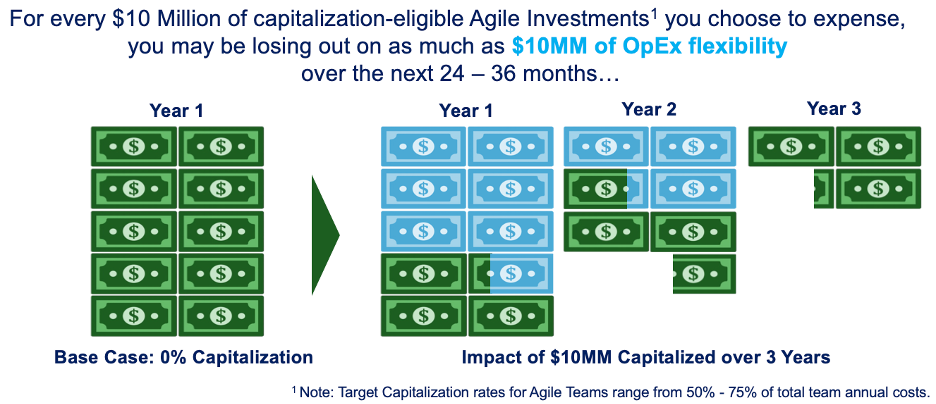
Figure 1
2. Increased accuracy in Financial Reporting
Agile Capitalization improves how labor is reported, aligning expenses with revenue over time. This avoids the misleading impression of high development costs during low-revenue periods and better reflects continuous innovation.
Figure 2
3. Incentivizes Core Agile Practices
Capitalization encourages consistent Agile practices such as:
-
-
Stable, cross-functional teams
-
Consolidated team backlogs
-
Estimation and planning based on team capacity
-
Inspect & adapt ceremonies
-
Transparent delivery metrics
-
4. Reduces Admin Overhead
Unlike traditional time tracking, Agile teams can track work using story points or velocity metrics, which are lighter-weight and aligned with existing workflows.
What Work Should Be Tracked?
Most activities within sprints or Kanban processes are eligible for capitalization, but it’s critical to label work types clearly in your Agile project management tools. Distinguish between capitalizable stories and expense-only activities (e.g., research spikes).

Figure 3
8 Steps to Launching an Agile Capitalization Proof of Concept (PoC)
Before rolling out Agile Capitalization at scale, test it with a proof of concept. Here’s our recommended 8-step approach:
1. Engage the Right Stakeholders
Involve finance, product, engineering, HR, audit, and controller groups. Capitalization impacts the bottom line—everyone needs a seat at the table.

Figure 4
2. Align on Goals
Align all stakeholders on the outcomes you want to achieve through Agile capitalization and the problems it will help your organization solve.
3. Agree on a PoC Approach
Ensure that all stakeholders agree on the notion of a PoC rather than jumping in too wide. It takes a little time for everyone to feel comfortable with the process and to iron out the kinks of an initiative like this.
4. Define Test Requirements
It’s important to ensure all parties are clear on what we are testing hoping to prove/validate with the PoC approach. It’s best to ensure everyone understands what data is needed so they can make the best decisions for full implementation.
5. Review CapEx vs. OpEx Criteria
Map current expense classification rules and create a decision tree. Share this with teams impacted by the change.
6. Choose a Tracking Method
Select a lightweight method for teams—story points, velocity tracking, or other Agile-native approaches.

7. Set Scope, Timeline & Outcomes
Define what teams will be involved, the PoC duration, and what success looks like.
8. Train & Support Participants
Educate everyone on the process and offer ongoing support. Feedback from these teams will inform broader rollout.
Evaluate Your Current Agile Capitalization Readiness
To understand your current state, use the Agile Capitalization Discovery Radar. This tool assesses:
-
Agile adoption
-
Data and systems maturity
-
Stakeholder alignment
-
Opportunity scope
Try the internal assessment with your teams—or explore the Kiosk version to get started.
Final Thoughts
Agile Capitalization is a powerful strategy to fund digital transformation, maximize resource efficiency, and gain financial clarity—all without disrupting your Agile practices. By following a structured PoC approach and aligning with GAAP guidelines, you can tap into a valuable source of hidden financial potential.
Looking for more? Watch our recent Agile Capitalization webinar or contact us to explore how this model could work for your organization.